The straight answer first
If you are driving from Nairobi, spend three nights in the Maasai Mara at the very least, and four if you can. If you are flying in, two nights will work but three is far better. If you are coming for the Great Migration river crossings between July and October, make it four or five nights and do not negotiate yourself down.
That is the whole answer in one paragraph, and if you only needed a number you can stop here. But I have planned Mara trips from our Nairobi office for a long time, and the number of nights is the thing guests most often get wrong. Usually they don’t get it wrong by being greedy. They get it wrong by being sensible: they trim the Mara to fit a Nairobi day, a beach extension or a budget, and then spend the trip wishing they had one more morning on the plains.
So this guide does something most “how many days” articles don’t. It stops counting days and starts counting game drives, because game drives are what you are actually buying. Then it runs that maths across road and fly-in trips, every season, every kind of traveller and every budget, so you can pick your number with your eyes open.
| Your situation | Minimum | What we recommend | Why |
|---|---|---|---|
| First safari, driving from Nairobi | 3 nights | 4 nights | The drive eats two half-days; you need two full days in the middle |
| First safari, flying in | 2 nights | 3 nights | Flying buys back about one good game drive, not a whole day |
| Great Migration, July–October | 4 nights | 5 nights | Crossings reward patience; every extra day raises your odds |
| The Mara as one stop on a Kenya circuit | 2 nights | 3 nights | Give the Mara the most nights of any park on the route |
| Photographers and returning safari-goers | 5 nights | 6 nights, split across two camps | Time to wait for light and behaviour, not just sightings |
| Families with young children | 3 nights | 3–4 nights with rest afternoons | Shorter drives, more of them, and no one melts down |
Why “days” is the wrong way to count
A “4-day Maasai Mara safari” sounds like four days of wildlife. It isn’t, and nobody is lying to you — it is simply how the industry counts. Day one includes the journey in. Day four includes the journey out. What you really get is two full days on the plains plus a partial day at each end.
Here is the unit that actually matters. A safari day in the Mara has two prime game-viewing windows: the early morning, from first light at around 6:15am until the heat builds late in the morning, and the late afternoon, from about 3:30pm until the reserve rules bring you home at dusk. Predators hunt, cats move, and the light is soft in those windows. In the middle of the day most animals lie flat in the shade, and so should you.
So a full day in the Mara is worth two game drives — or one long full-day drive with a picnic breakfast under a tree, which is how we usually run it, because it keeps you out in the far corners of the reserve instead of commuting back to camp for lunch. Either way, the currency is the same: prime-time hours on the plains. Count those, and every itinerary suddenly becomes easy to compare.
The game drive maths: two to six nights, by road and by air
Let me walk through what really happens on the arrival and departure days, because this is where the numbers come from.
By road, you leave Nairobi at around 7am, stop at the Rift Valley viewpoint, pass through Narok, and reach the reserve at roughly lunchtime after five to six hours. Your guide game-drives you in from the gate, you check in, rest for an hour, and head out for a proper afternoon drive. On departure day, road guests must exit the reserve by 10am or pay another full day of park fees — so your last morning is a dawn drive that ends at the gate, and then you are back on the road to Nairobi.
By air, you take a morning light-aircraft flight from Nairobi’s Wilson Airport and land on a Mara airstrip in time for lunch, with your guide already waiting beside the plane. That afternoon drive is a full one, and you are not stiff from six hours in a vehicle. On departure day, if you book the later flight out, you get a complete morning drive that finishes at the airstrip.
Put that together and the pattern is simple. By road, you get roughly two good drives for every night, minus one. By air, you get two good drives for every night. That is the honest difference.
| Nights in the Mara | Full days on the plains | Game drives by road | Game drives fly-in | Our honest verdict |
|---|---|---|---|---|
| 1 night | 0 | ~1 | ~2 | Not a Mara safari. Please don’t. |
| 2 nights | 1 | ~3 | ~4 | A taste. Works fly-in or as part of a longer circuit. |
| 3 nights | 2 | ~5 | ~6 | A real safari. The minimum we recommend by road. |
| 4 nights | 3 | ~7 | ~8 | The sweet spot for almost everyone. |
| 5 nights | 4 | ~9 | ~10 | Migration season, photographers, conservancy splits. |
| 6+ nights | 5+ | ~11+ | ~12+ | Specialists, and anyone who wants to slow right down. |
The myth that flying in “saves a day”
You will read — including on some well-ranked safari sites — that a three-night fly-in safari is worth the same as a four-night road safari. I understand why people say it, but look at the table again: three nights fly-in gives you about six drives, and four nights by road gives you about seven. Flying buys back roughly one good game drive. It does not buy back a day.
What flying really buys you is energy and flexibility, and those are worth a lot. You arrive fresh instead of dusty. You avoid the last stretch of rough road between Narok and the gate. And you can connect the Mara straight to somewhere else — Diani, Samburu, Amboseli — without looping back through Nairobi traffic. For older travellers, for anyone with back trouble, and for tight itineraries with a beach at the end, those are excellent reasons to fly.
But if you are choosing between flying in for three nights or driving in for four at a similar total cost, drive in for four. More time on the plains beats more comfort getting there, every single time.
One night: why we won’t sell you a Mara day trip
We get asked about Nairobi-to-Mara day trips and one-night “express” safaris most weeks. My answer is always the same: I would rather you spent that day at Nairobi National Park, the Giraffe Centre and the Sheldrick elephant orphanage, and came back to the Mara when you could give it properly.
A one-night Mara trip by road means around eleven hours in a vehicle for roughly two short game drives, one of them in the midday heat on arrival and the other a dawn drive cut short by the 10am exit rule. You will still pay a full day of reserve fees for it. You will almost certainly see animals — the Mara is generous — but you will spend more time on the road than on the plains, and you will leave with the feeling of having looked through a keyhole.
A one-night fly-in is less punishing, but at two flights and a night’s lodging for about two drives, it is among the most expensive wildlife hours in Africa. If a single night is all the time you have, choose a closer park and save the Mara.
Two nights: a taste, and when it genuinely works
Two nights gives you one full day on the plains, plus an afternoon drive on arrival and a morning drive on departure. By road that is about three quality drives. In a good week you will see lions, elephants, buffalo, giraffe, zebra, hippos in the river and a lot of plains game, and probably a cheetah. You will be moved. You may also leave with a nagging sense that the reserve kept most of its secrets.
Two nights works well in three situations. First, if you fly in, which turns it into four drives with no road fatigue. Second, if the Mara is one stop on a longer Kenya circuit and you have already had good game viewing in Amboseli or Samburu, so you are not relying on two nights for your whole safari — this is how our 6-day Kenya safari is built. Third, if you are a returning guest who knows exactly what you want and has booked a well-positioned camp.
Where two nights does not work is a first safari by road in the migration months. The river crossings are about patience, and one full day gives you almost none. If that is your plan, please read the next two sections before you book.
Three nights: the honest minimum for a first safari
Three nights is where the Mara starts to feel like a safari instead of a sampler. By road you get two full days in the middle — about five good drives — and that second full day changes everything. On day one your guide is showing you the Mara. On day two your guide is using what you both learned on day one: the pride you found resting near the Talek river, the cheetah with cubs on the open plains, the direction the herds were moving at dusk.
That continuity is what first-timers don’t expect. The best sightings are rarely lucky; they are the second or third visit to something your guide has been quietly tracking. Three nights gives your guide that second visit.
Three nights is also what our 4-day Masai Mara safari is built around: a road trip down the Rift Valley, two full days on the plains, a dawn drive out. For a first safari outside the migration months it is a very good trip, and for most guests from January to June it is all they need.
Four nights: the sweet spot, and why the fourth night matters so much
If I could choose one number for every guest who writes to us, it would be four nights. It gives three full days on the plains and about seven good drives by road. More importantly, it removes pressure from the trip, and pressure is the thing that quietly ruins safaris.
With three nights, every drive has a job to do. If it rains on your full day, if a vehicle gets a puncture, if you are jet-lagged and sleep through a morning, you have lost a real share of your safari. With four nights you can lose a morning and still leave happy. You can spend three hours with a leopard in a tree without feeling you are missing lions somewhere else. You can take the balloon safari on one dawn without giving up a game drive you will miss. You can say yes to a Maasai village visit, or to an afternoon by the pool.
The fourth night is also when the “hard” sightings start to show up. Almost everyone sees lions early. Cheetah usually appear within the first couple of days on the open plains. Leopard is the one extra time really buys: it is a shy, solitary cat in riverine thickets and rocky outcrops, and guides find it by returning to the right places again and again. And rhino, honestly, are rare in the Mara — a small population concentrated in a few areas — so if a rhino is on your list, extra days help, but a separate stop at Ol Pejeta or Lake Nakuru helps far more. Our Big Five guide covers where each animal lives.
Four nights is what I book for my own friends. That is probably the most useful sentence in this article.
Five, six, seven nights: who really needs that long
Five nights or more is not excess for the right person. It is simply a different kind of safari: less about ticking species, more about behaviour, light and time.
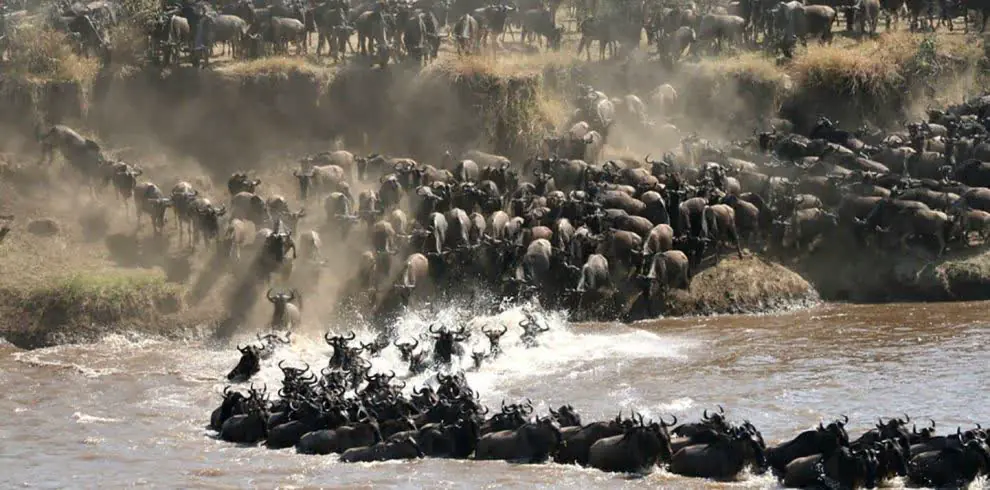
Migration travellers are the first group. Between July and October, a crossing can build for hours and then be called off because the wind changed. Five nights gives you four full days of chances, and the relaxed mindset to sit through a slow day without panic. Our river crossings guide explains why patience is the whole strategy.
Photographers are the second. Great wildlife images need a subject doing something in good light, and you cannot schedule either. Five or six nights gives you the dawn you need, and time to come back to a den site when the light is right instead of whenever you happen to pass.
The third group is anyone splitting their stay between the national reserve and a private conservancy — the combination I recommend most for a luxury or honeymoon trip. Two or three nights in the reserve for the big classic scenery and, in season, the river; then two or three nights in a conservancy for night drives, bush walks and sightings shared with only a few vehicles. Our guide to the private conservancies explains the difference in detail.
Seven nights or more is for specialists, researchers, serious birders and repeat visitors who just want to live in the Mara for a week. If that sounds like you, you already know it, and we would love to plan it.
How many days for the Great Migration and the river crossings?
This deserves its own section, because it is where under-booking hurts most. The herds are usually in the Mara from mid-July to late September or early October, and the river crossings happen during that window — but no one can tell you which day or which hour. A crossing is something you wait for.
Our recommendation is four nights minimum and five if you can. With four nights you get three full days of crossing chances and good odds. With five, the odds become strong and the waiting becomes enjoyable instead of stressful. With two, you are gambling a very expensive trip on a single day at the river.
Where you sleep matters as much as how long. In crossing season, a camp near the Mara River saves you an hour or more each way, which is effectively extra days. A cheaper lodge far from the river on a longer stay can deliver fewer crossing hours than a well-positioned camp on a shorter one. When you compare quotes, ask how far each camp is from the main crossing points, not only how many nights it includes.
If your dates fall outside the migration, don’t worry. The Mara’s resident lions, cheetahs, leopards and elephants don’t migrate, and our month-by-month Mara guide shows what each season does best.
How many days, month by month
The right length changes a little with the season, mostly because of the migration, the rains and the park fees. Here is how we plan it through the year.
| Months | What is happening | Reserve fee (non-resident adult) | Nights we recommend |
|---|---|---|---|
| January–March | Short grass, open plains, excellent big-cat viewing, fewer vehicles | $100 per day | 3 nights (4 for photographers) |
| April–May | Long rains: green, dramatic and quiet; some roads slow down and some camps close | $100 per day | 3–4 nights, fly-in worth considering |
| June | Drying out, grass is tall, herds approaching from the south | $100 per day | 3–4 nights |
| July–October | Great Migration and river crossings; peak demand and peak crowds | $200 per day (July–December) | 4–5 nights |
| November–December | Short rains, herds moving south, prices easing, Christmas busy | $200 per day | 3 nights |
How park fees change the number of days
You cannot answer “how many days” honestly without talking about money, because in the Mara the park fee is charged per day, per person, and it is now one of the biggest line items on the trip.
At 2026 rates set by Narok County, non-resident adults pay $100 per day in the reserve from January to June and $200 per day from July to December. Children aged 9 to 17 pay $50 per day, and younger children enter free. Road guests who leave after 10am on their departure day are charged another full day. These fees can change, so we confirm them in writing when we quote.
Here is what that means in practice. A couple spending four nights inside the reserve in August pays roughly $1,600 in park fees alone before accommodation, vehicle or food. The same four nights in March cost about $800. That $800 difference is almost a whole extra night of good mid-range accommodation for two.
Three ways we use this when planning. First, if your dates are flexible, the first half of the year gives you a longer Mara stay for the same money. Second, in peak season, moving some nights into a private conservancy replaces the reserve fee with a conservancy fee that is usually built into the camp rate — and gives you night drives and fewer vehicles as well. Third, we never quietly count fewer park days than your itinerary really uses. If a quote looks suspiciously cheap, check that first. Our Kenya safari cost guide has the full breakdown.
How many days, by kind of traveller
First-time safari-goers: three nights by road at minimum, four ideally. You will be learning how a safari works on the first day — how early starts feel, how to use binoculars, how to spot a leopard’s tail hanging from a branch. Give yourself time to become good at it.
Families with children: three to four nights, run differently. Instead of long full-day drives, we plan shorter morning and afternoon drives with a proper rest and a swim at camp in between. Children usually love the first two days and get restless on the third unless the rhythm changes, so we build in a Maasai village visit, a walk at camp with a guide, or a lazy afternoon. Note that some conservancy camps have minimum ages. Our family safari guide has the details.
Honeymooners: four nights, ideally split two and two between a reserve-side camp and a conservancy. Private game drives, a bush breakfast, a sundowner on a ridge and a night of complete silence in a small camp — none of that fits well into two nights.
Photographers: five to six nights, private vehicle, and a camp chosen for its location over its swimming pool. Tell us what you want to shoot and in which light, and we will build the days around it.
Travellers on a tight budget: three nights by road, between January and June, in a well-located mid-range camp. That is the best-value real Mara safari I know how to build. Cutting to two nights often saves less than people expect once the fuel and the long drive are counted.
Older travellers or anyone with limited mobility: three nights fly-in. The road between Narok and the gate can be bumpy, and flying removes most of the hardest travel while keeping the good drives.
Returning safari-goers: however long you like, but think about how you split it. A second Mara safari is a great time to try a different area — the Mara Triangle, a conservancy, or the quieter east of the reserve.
Driving or flying: how it changes your plan
The drive from Nairobi is about 270 km and takes five to six hours with a stop, most of it on tarmac through the Rift Valley and Narok, with the last stretch towards the gate rougher. It is part of the experience: the view from the escarpment over the valley floor is one of the great sights of Kenya, and by the time you reach the reserve you understand how far into the wild you have come. In a private vehicle, with a guide pointing things out and stops when you want them, it is far more pleasant than it sounds.
Scheduled light-aircraft flights leave Nairobi’s Wilson Airport in the morning and afternoon and take about 45 minutes to an hour, sometimes longer if your airstrip is the last of several stops. In 2026 expect roughly $200–$400 per person each way depending on the season and airline, and a luggage limit of about 15 kg per person in soft bags. Your guide meets you at the airstrip in the vehicle. Our full drive-or-fly guide covers the route stop by stop, the gates, the airstrips and the cost for families and groups.
| Driving | Flying | Drive in, fly out | |
|---|---|---|---|
| Time each way | 5–6 hours | About 1 hour plus airport time | One of each |
| Extra cost per person | Included with a private vehicle | Roughly $400–$800 return in 2026 | Roughly $200–$400 |
| Game drives on arrival day | Short afternoon drive after a long journey | Full afternoon drive, fresh | Short on arrival |
| Game drives on departure day | Dawn drive, out by 10am | Full morning drive with a later flight | Full morning drive |
| Luggage | No real limit | About 15 kg, soft bags | About 15 kg on the way out |
| Best for | Budget, first-timers who want to see Kenya | Short stays, older travellers, beach connections | Most of our guests |
Our favourite answer: drive in, fly out
Many of our guests end up with a combination that avoids most of the downsides. They drive in with their guide, enjoying the Rift Valley and arriving slowly into Kenya, and then fly out at the end, keeping the full final morning on the plains and connecting straight to the coast or to Nairobi for an evening international flight.
It costs roughly half as much as flying both ways, gives you the best departure morning, and puts the long drive at the start of the trip when you are excited — not at the end when you are tired and thinking about your flight. If Diani is next, our bush-to-beach guide explains how that connection works.
Sample plans: what three and four nights really look like
Here is a real rhythm for a four-night road safari in the Mara. For three nights, remove day three.
| Day | Morning | Middle of the day | Afternoon and evening |
|---|---|---|---|
| Day 1 — arrival | Leave Nairobi around 7am, Rift Valley viewpoint, Narok | Game drive in from the gate, lunch at camp, rest | First proper game drive until dusk |
| Day 2 — full day | Out at first light for the predators | Picnic breakfast and lunch out in the reserve, following the action | Back at dusk for a campfire |
| Day 3 — flexible day | Optional balloon flight, or dawn game drive | Rest at camp, or a Maasai village visit | Afternoon drive back to what you found on day 2 |
| Day 4 — full day | Early start for whatever you still want: leopard, crossings, cheetah hunt | Long day out, or rest if you’ve had enough | Sundowner drive and your last evening |
| Day 5 — departure | Dawn game drive to the gate, out by 10am | Drive back to Nairobi, lunch on the way | Arrive in Nairobi mid-afternoon |
Splitting your nights between camps
A longer stay raises a good question: should you stay in one camp or two? Each move costs you about half a day of packing, checking out and driving across the ecosystem, so the rule we use is simple — never stay in one camp for fewer than two nights.
That means three nights should almost always be one camp. With four nights you can do two and two, which works very well for a reserve-and-conservancy combination. With five or six nights, a split lets you see two very different parts of the Mara: the river and the open plains of the main reserve, and the quiet, off-road, night-driving world of a conservancy, or the beautiful Mara Triangle beneath the Oloololo escarpment.
If you want one camp for the whole stay, choose its location for the season. Near the river in migration months. Central to the big-cat areas in the rest of the year. Our Maasai Mara park guide covers the different areas.
Fitting the Mara into a longer Kenya trip
Most of our guests don’t visit only the Mara, and that raises the real question: out of your total days, how many should go to the Mara? Our rule, whichever of our Kenya itinerary ideas you start from, is that the Mara should get more nights than any other park on the route, because it has the greatest density and variety of wildlife in Kenya. Amboseli, Samburu, Naivasha and Nakuru are wonderful, but they support the Mara rather than replace it.
Also build in a Nairobi night on arrival if your international flight lands late or overnight. Arriving on a red-eye and then driving six hours to the Mara is the fastest way to sleep through your first game drive.
| Total Kenya trip | Mara nights | Typical rest of the trip |
|---|---|---|
| 4 days | 3 | The whole trip is the Mara — the best use of a short trip |
| 6 days | 2–3 | Amboseli and Lake Naivasha on the way |
| 7–8 days | 3 | Amboseli or Samburu, plus Naivasha or Nakuru |
| 10 days | 3–4 | Samburu or Ol Pejeta, Naivasha, Amboseli |
| 12–14 days with beach | 3–4 | Two other parks, then 4–5 nights in Diani |
The mistakes we see most often
Booking two nights by road in August. This is the most common one and the most painful: peak prices, peak park fees, and only one real day for the river crossings. If the migration is the reason for the trip, give it the time.
Counting nights instead of drives. Two quotes can both say “3 nights in the Mara” and be very different trips if one drives in and leaves on the last morning and the other has a camp two hours from the action.
Choosing the cheap camp far away. A lodge outside the reserve or at the far edge can add an hour or two of driving every day. Over three days, that can be a whole game drive lost.
Moving camp every night. Guests sometimes try to “see more” by changing lodges each night. You end up seeing more reception desks.
Arriving straight off a long-haul flight. Sleep in Nairobi first. The Mara will still be there tomorrow, and you will actually see it.
Planning no downtime. Safari days start before 6am. On a four-night trip, one quieter afternoon makes the rest of the trip better, especially with children.
Assuming a sighting list is guaranteed by length alone. More days raise your odds a lot, but the guide, the vehicle and the camp location matter just as much. Every White Horse safari is in a private vehicle with a window seat for everyone, and your guide stays as long at a sighting as you want — which makes every day worth more.
Our recommendation
If you remember one thing: three nights is the minimum for a real Mara safari by road, four nights is the sweet spot for almost everyone, and five nights is right for the migration. Flying in helps, but it buys back about one game drive, not a day.
After that, the right answer depends on your month, your budget, how you travel and what you most want to see — which is exactly the conversation we have with guests every day. Tell us your dates, who is travelling and what matters most on our plan-your-safari page or on WhatsApp, and we will tell you honestly how many nights the Mara deserves on your trip. Sometimes that answer is fewer than you expected. Usually it is one more.
Questions travelers ask
How many days do you need in the Maasai Mara?
Three nights by road is the minimum we recommend for a first safari, and four nights is the sweet spot. Fly-in guests can manage with two nights, but three is much better. For the Great Migration river crossings from July to October, plan four to five nights.
Is 2 days enough for the Maasai Mara?
Two nights gives you one full day on the plains plus a short drive on arrival and departure — about three good game drives by road or four if you fly in. It is enough to see a lot of wildlife, and it works as part of a longer Kenya circuit, but it is too short for a first safari by road or for the river crossings.
Is a day trip from Nairobi to the Maasai Mara worth it?
No. It means around eleven hours of driving for a very short time in the reserve, plus at least a full day of park fees. If you only have one day, visit Nairobi National Park, the Giraffe Centre and the Sheldrick elephant orphanage instead, and save the Mara for a trip of at least three nights.
3 days or 4 days in the Maasai Mara — which is better?
Four, if you can. A 4-day road safari is three nights, which is two full days on the plains and about five good game drives. Adding a fourth night adds a third full day, about seven drives, and — most importantly — takes the pressure off, so a rainy morning or a long wait at the river doesn’t cost you your safari.
How many days do I need for the Great Migration river crossings?
Four nights minimum, five for relaxed odds, between mid-July and late September. Crossings cannot be predicted to the day, so time and a camp close to the Mara River matter more than anything else.
Is it worth flying to the Maasai Mara instead of driving?
Flying saves five to six hours each way and adds about one full game drive to your stay, but costs roughly $400–$800 per person return in 2026 with a 15 kg soft-bag luggage limit. It is worth it for short stays, older travellers and connections to the coast. Driving in and flying out is a good compromise for many guests.
How long is the drive from Nairobi to the Maasai Mara?
About five to six hours to the main gates, roughly 270 km, with a stop at the Great Rift Valley viewpoint and usually in Narok. Most of the road is tarmac, with a rougher final stretch near the reserve.
Can you see the Big Five in 3 days in the Maasai Mara?
You can see lions, elephants and buffalo on almost any three-night safari, and leopards often, especially with a skilled guide. Rhinos are the hard one: the Mara has a small population and sightings are rare. If the full Big Five matter to you, add a night in the Mara and a stop at Ol Pejeta or Lake Nakuru, where rhinos are far easier to see.
How much are Maasai Mara park fees per day?
At 2026 rates, non-resident adults pay $100 per day from January to June and $200 per day from July to December. Children aged 9–17 pay $50 per day and younger children are free. Guests leaving by road must exit by 10am or pay another day. Fees are set by Narok County and can change.
How many days should I spend in the Maasai Mara with kids?
Three to four nights, with shorter morning and afternoon drives and a rest at camp in the middle of the day. Children usually do best with a varied rhythm, such as a Maasai village visit or a pool afternoon, rather than long full-day drives.