The four routes, compared
Mount Kenya has four trekking routes to the Point Lenana side of the mountain, and the choice shapes everything: how well you acclimatise, what you look at all day, and how likely you are to stand on the summit at dawn. Three are in common use. The fourth, Burguret, is a genuine wilderness route with no huts and almost no traffic.
If you only remember one thing: ascend Sirimon and descend Chogoria. It gives you the gentlest acclimatisation profile on the way up and the most spectacular scenery on the way down, and you never repeat a step. That is exactly how our 4-day Sirimon–Chogoria trek is built.
| Route | Side | Days up | Acclimatisation | What it is for |
|---|---|---|---|---|
| Sirimon | North-west | 2–3 | Best — gradual, dry, two good camps | The default ascent. Yellowwood forest, then the wide Mackinder Valley |
| Chogoria | East | 2–3 | Good, but a long day three | The most beautiful walking in Kenya: Lake Michaelson, Gorges Valley, the Temple cliffs |
| Naro Moru | West | 2 | Weakest — fastest height gain | Speed and budget. Includes the boggy stretch politely called the Vertical Bog |
| Burguret | West | 3 | Good, but unsupported | Wilderness and solitude: no huts, rough trail, experienced trekkers only |
Choosing your route in practice
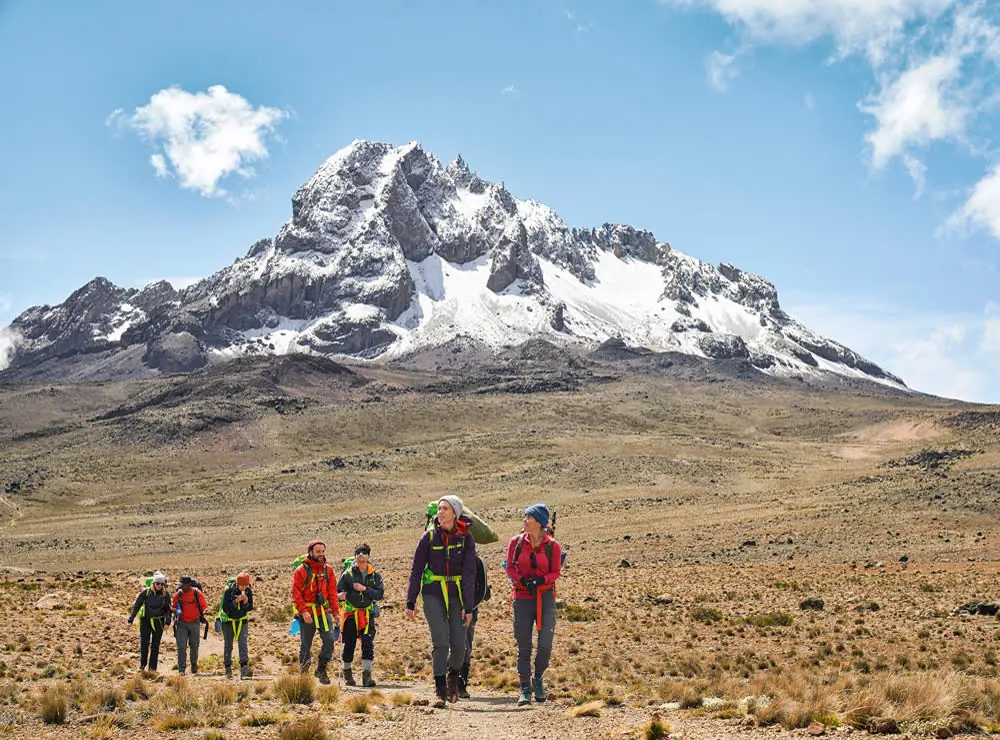
Sirimon, from the north-west, is the gentlest climb and the one we recommend by default. It is on the drier side of the mountain, the gradient is forgiving, and the staged camps at Old Moses (3,300 m) and Shipton’s (4,200 m) break the altitude sensibly. Most people who summit comfortably came up this way.
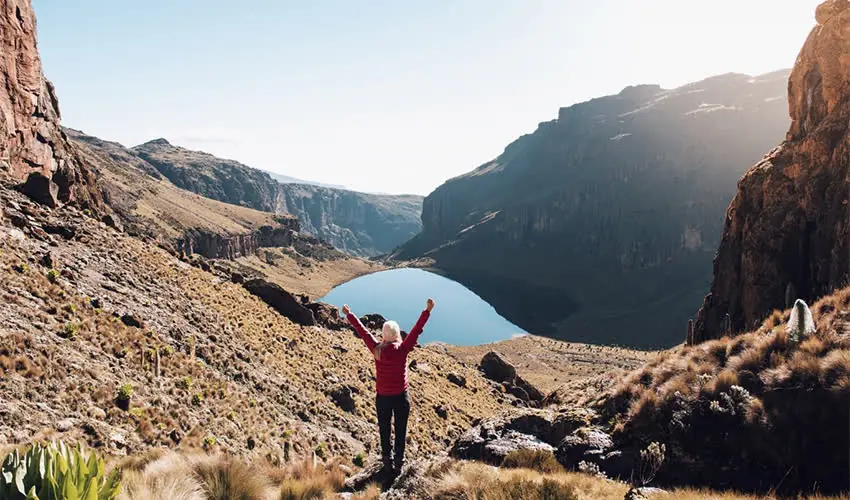
Chogoria, from the east, is flatly the most scenic route in the country. The trail passes Lake Michaelson in its vast amphitheatre of cliffs, skirts the Gorges Valley and runs under the Temple. It is a longer walk and the third day is a big one, which is why we prefer it as a descent — you get the views with gravity on your side.
Naro Moru is the fastest way up and the hardest on the body. It climbs through the Vertical Bog, gains height quickly, and has the lowest summit success rate of the three for exactly that reason. It is a reasonable choice if your time is genuinely fixed, and a poor one otherwise.
Burguret is the route for people who have done the others. There are no huts, the path is faint in places, and you camp. In exchange you may not see another group all week.
How hard is Mount Kenya, honestly?
Point Lenana at 4,985 m needs no ropes, no crampons on the normal summer line and no technical skill. It is a trek, not a climb. What it does need is respect for altitude: it is only 110 m short of five thousand metres, and the people who fail are almost always the people who went too fast rather than the people who were unfit.
Reasonably fit walkers who can manage six to eight hours a day on consecutive days will be fine. There is no climbing, but there is scree, there are long days, and summit morning starts around 3am by headlamp in real cold. If you can walk a hilly 20 km day at home without dreading the next one, you have the fitness.
The altitude is the real variable, and it is not correlated with fitness or age. Headache, poor sleep and loss of appetite above 4,000 m are normal; worsening symptoms are not, and the only reliable treatment is to go down. Our guides carry a pulse oximeter and make that call early, which is the whole argument for a proper operator rather than the cheapest one.
Can you climb Mount Kenya without a guide? You are required to enter the park with a registered guide, and quite apart from the rule it is a bad idea: the summit approach is unobvious in the dark, the weather turns fast, and evacuation from 4,800 m is not something to improvise. Porters are optional; a guide is not.
How long it takes
Four days is the working minimum and five is materially safer. The difference is one extra night at altitude, and on a mountain where altitude is the limiting factor that one night buys a noticeably higher chance of standing on the summit.
Our 4-day Sirimon–Chogoria trek runs Sirimon Gate to Old Moses (3,300 m), up to Shipton’s Camp (4,200 m), over Point Lenana at dawn and down the Chogoria side to Meru Bandas (2,950 m), then out to Chogoria town. The 5-day Chogoria–Naro Moru trek adds an acclimatisation day and takes in the Chogoria scenery on the way up instead.
Three-day itineraries exist. We do not sell them: they put you above 4,000 m on your second day with no spare night, and the summit success rate reflects that.
| Itinerary | Nights on the mountain | Highest camp | Summit odds | Who it suits |
|---|---|---|---|---|
| 3 days | 2 | Shipton's or Mackinder's | Poor — no margin for altitude | Nobody, in our view |
| 4 days | 3 | Shipton's (4,200 m) | Good with a sensible pace | Fit trekkers on a fixed schedule |
| 5 days | 4 | Shipton's (4,200 m) | Strong — an extra acclimatisation night | Most people, and anyone new to altitude |
| 6+ days | 5+ | Varies | Highest | Photographers, Burguret, and the tarn circuit |
The best time to climb
Mount Kenya has two dry windows, and they are the two you want: January to February, and late August through September. In those months the rock is dry, the paths are firm and the summit mornings are clear often enough to plan around.
The long rains from late March into May are the worst time to be on the mountain: the Vertical Bog lives up to its name, the Chogoria descent gets slippery and views close in. The short rains around November are less disruptive but still make camp life wet.
Because the mountain sits almost exactly on the equator, the daily swing matters more than the season. Expect well below freezing on summit morning and strong equatorial sun by ten o’clock the same day, every month of the year.
Point Lenana, and the summits that are not trekking
Mount Kenya has three summits and only one of them is a walk. Point Lenana, 4,985 m, is the trekking peak and the one every itinerary on this page refers to. It is the third-highest point on the mountain and the highest you can reach without climbing equipment.
Batian (5,199 m) and Nelion (5,188 m), the true twin summits, are serious technical rock climbs on a remote mountain, usually done over two days with a bivouac on Nelion. They need a qualified mountain guide, a rack and prior multi-pitch experience. If that is what you are after, tell us and we will put you with the right people — it is a different trip, not an upgrade.
Permits, costs and what you carry
Park fees are charged per person per day by the Kenya Wildlife Service and are the single largest fixed cost of the trek; they are included in our itineraries along with the registered guide, porters, hut or camping fees and all meals on the mountain. Ask any operator to itemise those five things, because a quote that looks cheap is usually a quote missing one of them.
You carry a daypack: water, layers, camera, snacks. Porters carry the rest. What you need is a proper four-season sleeping bag, a windproof and waterproof outer layer, a warm mid-layer, broken-in boots with ankle support, gloves, a hat, high-factor sunscreen and a headtorch with spare batteries for summit morning. You can hire most of the heavy items in Nanyuki rather than flying them in.
Nanyuki and Naro Moru are the base towns, roughly three hours north of Nairobi, and the drive up through the highlands is scenic in its own right.
Combining the trek with a safari
This is the thing Kilimanjaro cannot offer: the safari is right next door. Ol Pejeta’s rhinos are about an hour from the Nanyuki trailhead, and Samburu is a couple of hours beyond that. A week that summits Point Lenana and then puts you on the Ewaso Ng’iro with the elephants is, for our money, the best adventure itinerary in Kenya — and our Northern Treasures route is built exactly that way.
The order matters. Trek first, safari second. Game drives are a gift after four days of walking, and you want the mountain while your legs are fresh rather than after a week of early starts.
Questions travelers ask
Do I need climbing experience for Mount Kenya?
Not for Point Lenana. It is a guided trek that rewards good fitness and a sensible pace, with no ropes or technical skill required. Only the twin summits of Batian and Nelion are technical rock climbs.
How hard is it to climb Mount Kenya?
Moderately hard, and the difficulty is altitude rather than terrain. Expect six to eight hours of walking a day and a 3am start on summit morning at 4,985 m. Reasonably fit hill walkers manage it; the people who fail are usually those who climbed too fast.
How many days do you need to climb Mount Kenya?
Four days is the minimum and five is safer. The extra night at altitude measurably improves your chance of reaching Point Lenana. We do not run three-day itineraries because they leave no margin for acclimatisation.
What is the best route up Mount Kenya?
Up Sirimon and down Chogoria is the classic answer: the gentlest ascent profile combined with the most spectacular descent, past Lake Michaelson, without repeating a step. Naro Moru is faster but has the weakest acclimatisation.
What is the best time to climb Mount Kenya?
January to February and late August through September are the two dry windows. Avoid the long rains from late March to May, when the paths are wet and the views close in.
Can you climb Mount Kenya without a guide?
No. A registered guide is required to enter the park, and the summit approach in the dark, the speed of the weather and the difficulty of evacuation from above 4,500 m all make it unwise regardless of the rule. Porters are optional.
Mount Kenya or Kilimanjaro?
Kilimanjaro is higher and carries the name; Mount Kenya is quieter, cheaper, more beautiful on the trail, and pairs directly with a safari. Many trekkers use Mount Kenya as the smarter acclimatisation-friendly alternative, or as the warm-up.
How high is Point Lenana?
4,985 metres. It is the trekking summit and the third-highest point on the mountain, after the technical peaks of Batian (5,199 m) and Nelion (5,188 m).